
Dealing with a Neighbor’s Noisy AC Unit in the Compact Lots of Italian Village
Living in Italian Village means enjoying historic brick homes and tree-lined streets but also dealing with close-quarter living where your neighbor’s air conditioner might be just feet from your bedroom window. When that outdoor unit starts rattling, buzzing, or humming at all hours, it creates more than just an annoyance—it can disrupt sleep, outdoor gatherings, and your overall quality of life. The good news is that Columbus has specific noise ordinances, and there are proven HVAC solutions to address excessive AC noise without escalating to legal battles. Columbus City Code Chapter 2329.
Columbus City Code Chapter 2329 defines unreasonable noise as any sound that disturbs the peace and quiet of a neighborhood. For residential areas like Italian Village, this typically means anything above 60 decibels during daytime hours and 50 decibels at night measured from your property line. Most modern AC units operate between 50-70 decibels, but older or malfunctioning units can easily exceed these limits, especially when compressors wear out or vibration isolation fails.
Understanding Columbus Noise Ordinances (Chapter 2329)
Columbus City Code Section 2329.11 specifically addresses noise control in residential districts. The ordinance prohibits any noise that is unreasonably loud, disturbing, and unnecessary. While the code doesn’t set specific decibel limits for all situations, it establishes that noise measured at 60 decibels or higher during daytime hours (7 AM to 10 PM) and 50 decibels or higher during nighttime hours (10 PM to 7 AM) is presumed to be unreasonable if it disturbs the peace.
Italian Village falls within the High Street-High Street corridor where older homes were built with minimal setbacks between properties. Many homes in the 43201 zip code have outdoor units placed just 5-10 feet from a neighbor’s window or patio. This proximity makes even normal operating sounds seem excessive. The Columbus Division of Police handles noise complaints through their non-emergency line, and the Columbus Public Health Department can issue citations for persistent violations. Where to Find 24 Hour Emergency HVAC Help Anywhere in Columbus.
Before filing a formal complaint, consider that your neighbor might not realize their unit is causing problems. Many homeowners are unaware of the noise levels their AC produces, especially if they’re at work during the day when the unit runs most frequently. A friendly conversation about the specific times and nature of the disturbance often resolves the issue without involving city authorities.
How Many Decibels is Too Loud for a Residential AC?
Understanding decibel levels helps you determine if your neighbor’s AC is truly excessive. Here’s a comparison of common sound levels:
| Sound Source | Decibel Level | Perceived Loudness |
|---|---|---|
| Whisper | 20 dB | Very Quiet |
| Library | 40 dB | Quiet |
| Normal Conversation | 60 dB | Moderate |
| Window AC Unit | 50-70 dB | Moderate to Loud |
| Italian Village AC Complaint | 70-85 dB | Loud to Very Loud |
| Lawn Mower | 90 dB | Very Loud |
| Rock Concert | 120 dB | Extremely Loud |
A properly functioning modern AC unit should operate between 50-60 decibels from 20 feet away. If you’re hearing rattling, grinding, or loud humming from your neighbor’s unit, it likely exceeds acceptable levels. The difference between 60 dB and 80 dB isn’t just 20 points—it’s perceived as roughly four times louder due to the logarithmic nature of the decibel scale.
Italian Village’s historic district status means many homes have original or aging HVAC systems. Units over 10-15 years old often develop noise issues due to worn bearings, loose compressor mounts, or failing fan motors. The compact lot sizes in this area amplify these sounds, making a 70 dB unit sound more like 80 dB when it’s just feet from your window. Troubleshooting AC Issues.
Steps to Take When a Neighbor’s AC is Disrupting Your Peace
Before escalating to city enforcement, follow these steps to address the noise diplomatically:
- Document the Noise
Keep a log of when the noise occurs, how long it lasts, and what it sounds like. Use a smartphone decibel meter app to measure levels when the unit runs. This documentation proves valuable if you need to involve authorities later. Upgrading to a Smart Thermostat in Grandview Heights to Lower Your Electric Bill.
- Approach Your Neighbor
Choose a calm time to talk, not when you’re frustrated by the noise. Explain the specific problem—when it happens, how it affects you, and that you’re looking for a solution together. Most people want to be good neighbors and may not realize there’s an issue.
- Suggest Professional Assessment
Offer to split the cost of a professional HVAC inspection. A technician can identify if the unit needs maintenance, repairs, or noise-dampening modifications. This approach shows you’re solution-oriented rather than confrontational. Why Your Westerville AC Needs a Tune Up Before the Humidity Hits.
- Explore Compromise Solutions
Consider options like running the AC during different hours, installing sound barriers, or adjusting the thermostat schedule. Sometimes simple timing changes can resolve the issue without any repairs needed.
- Involve Mediation Services
If direct conversation doesn’t work, Franklin County offers free neighbor mediation through the Community Mediation Services. A neutral third party can help both sides find acceptable solutions.
Many Italian Village residents find success with this step-by-step approach. The neighborhood’s strong community spirit means most people prefer resolving disputes amicably. If your neighbor agrees to an inspection, Grand HVAC Columbus can assess the unit and recommend specific solutions that address both the noise and the underlying mechanical issues.
Mechanical Causes of Excessive AC Noise
Understanding why an AC unit becomes noisy helps you identify the root cause and potential solutions. Here are the most common mechanical issues that create excessive noise:
- Loose Compressor Mounts – Over time, rubber isolation feet deteriorate, allowing the compressor to vibrate against the unit’s frame. This creates a loud buzzing or rattling sound that carries through the structure.
- Worn Bearings – Fan motors develop worn bearings that create a high-pitched whine or grinding noise. This typically worsens as the unit runs longer.
- Debris in the Condenser Fan – Leaves, sticks, or other debris caught in the outdoor fan create clicking or scraping sounds as the blades hit obstructions.
- Refrigerant Issues – Low refrigerant levels or restrictions in the lines can cause the compressor to work harder, creating unusual gurgling or hissing sounds.
- Misaligned Fan Blades – Bent or loose fan blades create an unbalanced spinning motion that produces loud thumping or clicking noises.
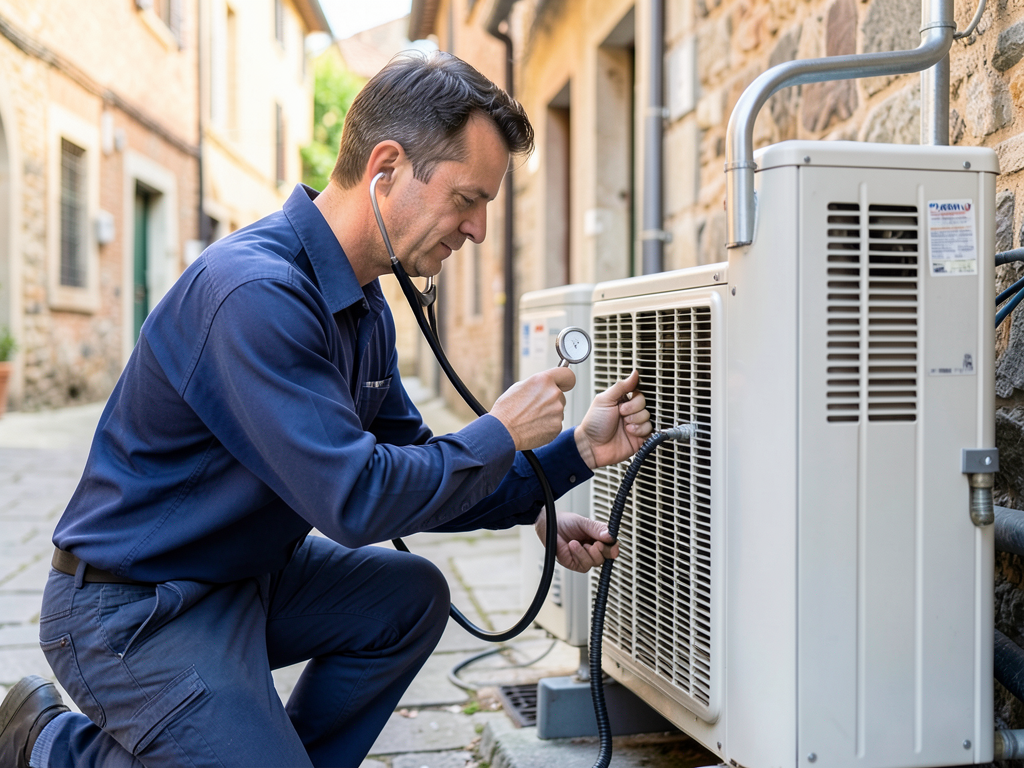
A diagnostic test we perform involves using a mechanic’s stethoscope to isolate the noise source. By touching the probe to different components while the unit runs, we can pinpoint whether the compressor, fan motor, or another part is causing the excessive noise. This precise diagnosis prevents unnecessary repairs and ensures we address the actual problem.
Italian Village’s humid climate also contributes to AC noise issues. The high moisture content in the air means units work harder and longer during summer months, accelerating wear on components. Units that might operate quietly for eight months of the year can become problematic during peak cooling season when they run continuously.
HVAC Solutions to Reduce Noise Complaints
Professional HVAC services offer several solutions to reduce AC noise without replacing the entire unit. Here are the most effective options:
| Solution | Noise Reduction | Cost Range | Best For |
|---|---|---|---|
| Sound Blanket Installation | 5-10 dB | $150-300 | Compressor noise |
| Vibration Isolation Pads | 3-7 dB | $75-200 | Vibration transmission |
| Compressor Repair/Replacement | 10-20 dB | $400-1,500 | Worn compressors |
| Fan Motor Replacement | 5-15 dB | $300-800 | Noisy fan issues |
| Complete Condenser Replacement | 15-25 dB | $2,000-4,000 | Old, inefficient units |
Sound blankets are one of the most cost-effective solutions for compressor noise. These specialized acoustic wraps fit around the compressor, absorbing sound waves before they can radiate outward. Modern sound blankets can reduce compressor noise by up to 10 decibels without affecting unit performance or efficiency.
Vibration isolation pads work by decoupling the unit from the concrete pad or mounting surface. These rubber or composite pads absorb vibrations that would otherwise travel through the structure and into your neighbor’s home. They’re particularly effective for units on wooden decks or elevated platforms where vibrations can resonate through the framing.
For severe noise issues, replacing the entire condenser unit might be the most economical long-term solution. Modern high-efficiency units operate significantly quieter than units from 10-15 years ago. A new unit with a variable-speed compressor can reduce noise levels by 15-25 decibels while also lowering energy costs by 20-40%.
When to Contact Columbus Code Enforcement
If diplomatic approaches fail and the noise continues to violate city ordinances, filing a formal complaint with Columbus Code Enforcement becomes necessary. Here’s when and how to proceed:
Document everything before contacting authorities. Keep your noise log, decibel readings, and records of any conversations with your neighbor. When you’re ready to file, contact Columbus 311 either by phone at 311 or through their online portal at https://311.columbus.gov. Provide specific details about the noise, including times, duration, and your documentation.
Columbus Code Enforcement will typically send an inspector to measure the noise levels from your property line. They’ll compare readings against the city’s noise ordinance and may issue a warning or citation if the unit exceeds allowable levels. The process usually takes 2-4 weeks from complaint to resolution.
Remember that code enforcement is a last resort. The goal should be finding a solution that works for both neighbors. Many Italian Village residents have successfully resolved AC noise issues through the steps outlined above without involving city authorities.
Grand HVAC Columbus understands the unique challenges of Italian Village living. Our technicians are familiar with the historic homes, compact lot sizes, and community dynamics that make this neighborhood special. We offer free consultations to assess noise issues and provide honest recommendations for resolution. Call (380) 253-3188 today to schedule your inspection and take the first step toward peaceful coexistence with your neighbor’s AC unit. The Honest Guide to Replacing Your Upper Arlington Furnace This Winter.
Frequently Asked Questions
How do I measure if my neighbor’s AC is too loud?
Use a smartphone decibel meter app to measure noise levels from your property line when the unit runs. If readings consistently exceed 60 dB during daytime or 50 dB at night, it likely violates Columbus noise ordinances.
Can I force my neighbor to fix their noisy AC?
Not directly, but if the noise violates city ordinances, you can file a complaint with Columbus Code Enforcement. They have the authority to require repairs or modifications to bring the unit into compliance.
How much does it cost to reduce AC noise?
Costs vary widely based on the solution. Simple fixes like sound blankets cost $150-300, while complete unit replacement runs $2,000-4,000. Many issues can be resolved for under $500 with proper diagnosis.
Will a new AC unit be quieter than my neighbor’s old one?
Yes. Modern high-efficiency units typically operate 10-20 decibels quieter than units from 10-15 years ago. They also use less energy and provide better cooling performance.
Should I call the police about a noisy AC?
Start with Columbus 311 or Code Enforcement rather than police. They have specific procedures for handling noise complaints and can measure decibel levels to determine if ordinances are being violated.
You may also find this helpful. Venting and Airflow Challenges for a Small German Village Carriage House.
You may also find this helpful. Navigating HVAC Rules and Restrictions for Your Downtown Columbus Condo.
{
“@context”: “https://schema.org”,
“@type”: “BlogPosting”,
“headline”: “Dealing with a Neighbor’s Noisy AC Unit in the Compact Lots of Italian Village”,
“description”: “Learn Columbus noise ordinances, decibel limits, and HVAC solutions for noisy AC units in Italian Village. Call (380) 253-3188 for expert help.”,
“wordCount”: 1850,
“datePublished”: “2026-05-31T13:46:00.000Z”,
“dateModified”: “2026-05-31T13:46:00.000Z”,
“inLanguage”: “en-US”,
“mainEntityOfPage”: {
“@type”: “WebPage”,
“@id”: “https://grandhvaccolumbus.com”
},
“publisher”: {
“@type”: “LocalBusiness”,
“name”: “Grand HVAC Columbus”,
“url”: “https://grandhvaccolumbus.com”
},
“author”: {
“@type”: “Organization”,
“name”: “Grand HVAC Columbus”,
“url”: “https://grandhvaccolumbus.com”
},
“image”: {
“@type”: “ImageObject”,
“url”: “https://grandhvaccolumbus.com/wp-content/uploads/2026/03/dealing-with-a-neighbor-s-noisy-ac-unit-in-the-com-1.png”
}
}
{
“@context”: “https://schema.org”,
“@type”: “HVACBusiness”,
“name”: “Grand HVAC Columbus”,
“url”: “https://grandhvaccolumbus.com”,
“address”: {
“@type”: “PostalAddress”,
“addressLocality”: “Columbus”
},
“areaServed”: {
“@type”: “City”,
“name”: “Columbus”
}
}
{
“@context”: “https://schema.org”,
“@type”: “FAQPage”,
“mainEntity”: [
{
“@type”: “Question”,
“name”: “How Many Decibels is Too Loud for a Residential AC?”,
“acceptedAnswer”: {
“@type”: “Answer”,
“text”: “Understanding decibel levels helps you determine if your neighbor’s AC is truly excessive. Here’s a comparison of common sound levels:”
}
},
{
“@type”: “Question”,
“name”: “How do I measure if my neighbor’s AC is too loud?”,
“acceptedAnswer”: {
“@type”: “Answer”,
“text”: “Use a smartphone decibel meter app to measure noise levels from your property line when the unit runs. If readings consistently exceed 60 dB during daytime or 50 dB at night, it likely violates Columbus noise ordinances.”
}
},
{
“@type”: “Question”,
“name”: “Can I force my neighbor to fix their noisy AC?”,
“acceptedAnswer”: {
“@type”: “Answer”,
“text”: “Not directly, but if the noise violates city ordinances, you can file a complaint with Columbus Code Enforcement. They have the authority to require repairs or modifications to bring the unit into compliance.”
}
},
{
“@type”: “Question”,
“name”: “How much does it cost to reduce AC noise?”,
“acceptedAnswer”: {
“@type”: “Answer”,
“text”: “Costs vary widely based on the solution. Simple fixes like sound blankets cost $150-300, while complete unit replacement runs $2,000-4,000. Many issues can be resolved for under $500 with proper diagnosis.”
}
},
{
“@type”: “Question”,
“name”: “Will a new AC unit be quieter than my neighbor’s old one?”,
“acceptedAnswer”: {
“@type”: “Answer”,
“text”: “Yes. Modern high-efficiency units typically operate 10-20 decibels quieter than units from 10-15 years ago. They also use less energy and provide better cooling performance.”
}
},
{
“@type”: “Question”,
“name”: “Should I call the police about a noisy AC?”,
“acceptedAnswer”: {
“@type”: “Answer”,
“text”: “Start with Columbus 311 or Code Enforcement rather than police. They have specific procedures for handling noise complaints and can measure decibel levels to determine if ordinances are being violated.”
}
}
]
}
{
“@context”: “https://schema.org”,
“@type”: “HowTo”,
“name”: “Resolving AC Noise Disputes”,
“step”: [
{
“@type”: “HowToStep”,
“position”: 1,
“name”: “Document the Noise”,
“text”: “Keep a log of when the noise occurs, how long it lasts, and what it sounds like. Use a smartphone decibel meter app to measure levels when the unit runs. This documentation proves valuable if you need to involve authorities later. Upgrading to a Smart Thermostat in Grandview Heights to Lower Your Electric Bill.”
},
{
“@type”: “HowToStep”,
“position”: 2,
“name”: “Approach Your Neighbor”,
“text”: “Choose a calm time to talk, not when you’re frustrated by the noise. Explain the specific problem—when it happens, how it affects you, and that you’re looking for a solution together. Most people want to be good neighbors and may not realize there’s an issue.”
},
{
“@type”: “HowToStep”,
“position”: 3,
“name”: “Suggest Professional Assessment”,
“text”: “Offer to split the cost of a professional HVAC inspection. A technician can identify if the unit needs maintenance, repairs, or noise-dampening modifications. This approach shows you’re solution-oriented rather than confrontational. Why Your Westerville AC Needs a Tune Up Before the Humidity Hits.”
},
{
“@type”: “HowToStep”,
“position”: 4,
“name”: “Explore Compromise Solutions”,
“text”: “Consider options like running the AC during different hours, installing sound barriers, or adjusting the thermostat schedule. Sometimes simple timing changes can resolve the issue without any repairs needed.”
},
{
“@type”: “HowToStep”,
“position”: 5,
“name”: “Involve Mediation Services”,
“text”: “If direct conversation doesn’t work, Franklin County offers free neighbor mediation through the Community Mediation Services. A neutral third party can help both sides find acceptable solutions.”
}
],
“image”: “https://grandhvaccolumbus.com/wp-content/uploads/2026/03/dealing-with-a-neighbor-s-noisy-ac-unit-in-the-com-1.png”
}
{
“@context”: “https://schema.org”,
“@type”: “BreadcrumbList”,
“itemListElement”: [
{
“@type”: “ListItem”,
“position”: 1,
“name”: “Home”,
“item”: “https://grandhvaccolumbus.com”
},
{
“@type”: “ListItem”,
“position”: 2,
“name”: “Blog”,
“item”: “https://grandhvaccolumbus.com/blog”
},
{
“@type”: “ListItem”,
“position”: 3,
“name”: “Dealing with a Neighbor’s Noisy AC Unit in the Compact Lots of Italian Village”
}
]
}
{
“@context”: “https://schema.org”,
“@type”: “Service”,
“serviceType”: “HVAC”,
“provider”: {
“@type”: “LocalBusiness”,
“name”: “Grand HVAC Columbus”,
“url”: “https://grandhvaccolumbus.com”
},
“areaServed”: {
“@type”: “City”,
“name”: “Columbus”
},
“description”: “Learn Columbus noise ordinances, decibel limits, and HVAC solutions for noisy AC units in Italian Village. Call (380) 253-3188 for expert help.”
}